
Despite Record Royalties, Danielle Smith is Desperate for More Oil Cash
Will producing more oil and building more pipelines solve the problem Alberta is actually trying to fix?

“Alberta has the highest oil production in history with record high royalties…But the UCP has done something no Alberta government has; they’ve wasted a boom during the boom.” NDP Leader Naheed Nenshi, press release, Feb. 26
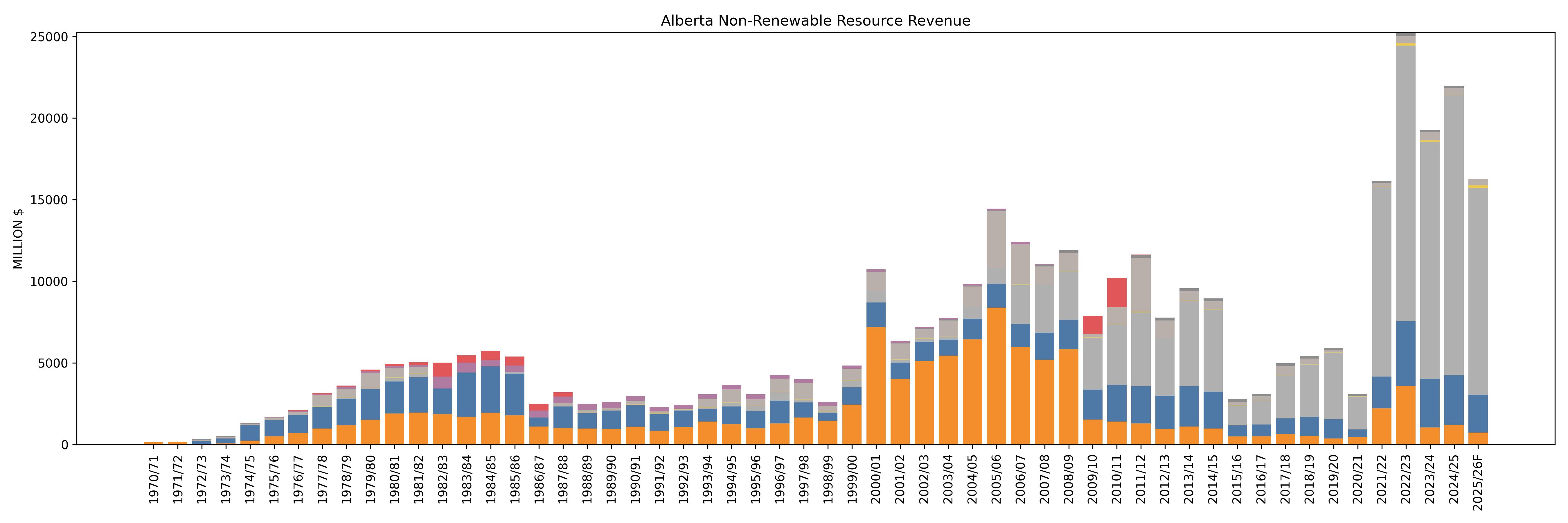
The rapid rise in Alberta's resource revenue under Danielle Smith is astonishing. A record $25 billion in 2022/23, Premier Danielle Smith’s first year, and much higher numbers than under previous premiers. The bonanza explains, in part, why the UCP government is doubling down on oil and gas despite clear evidence that big changes are underway in the global energy system. Some oil revenue good, more oil revenue better, seems to be the mantra.
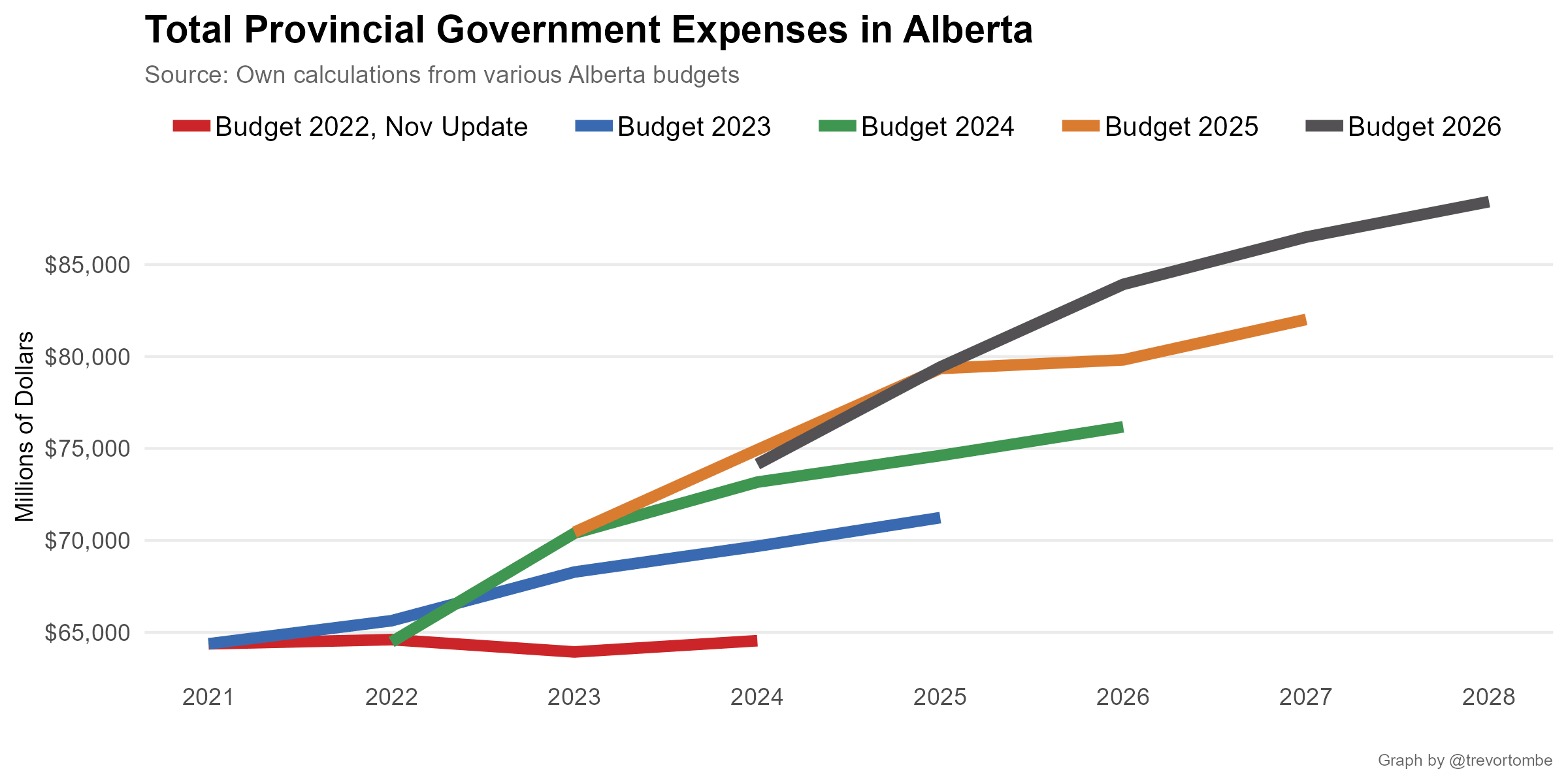
Much of the post-budget analysis has focused on high resource revenue, deteriorating public services (e.g. healthcare), and this budget’s projected $9.4 billion deficit. University of Calgary economics professor Trevor Tombe drew attention to the significant growth of spending under Smith: “The ratcheting up of provincial spending continued in Alberta's 2026 budget. This year, ~$4.1 billion higher than was planned one year ago.”
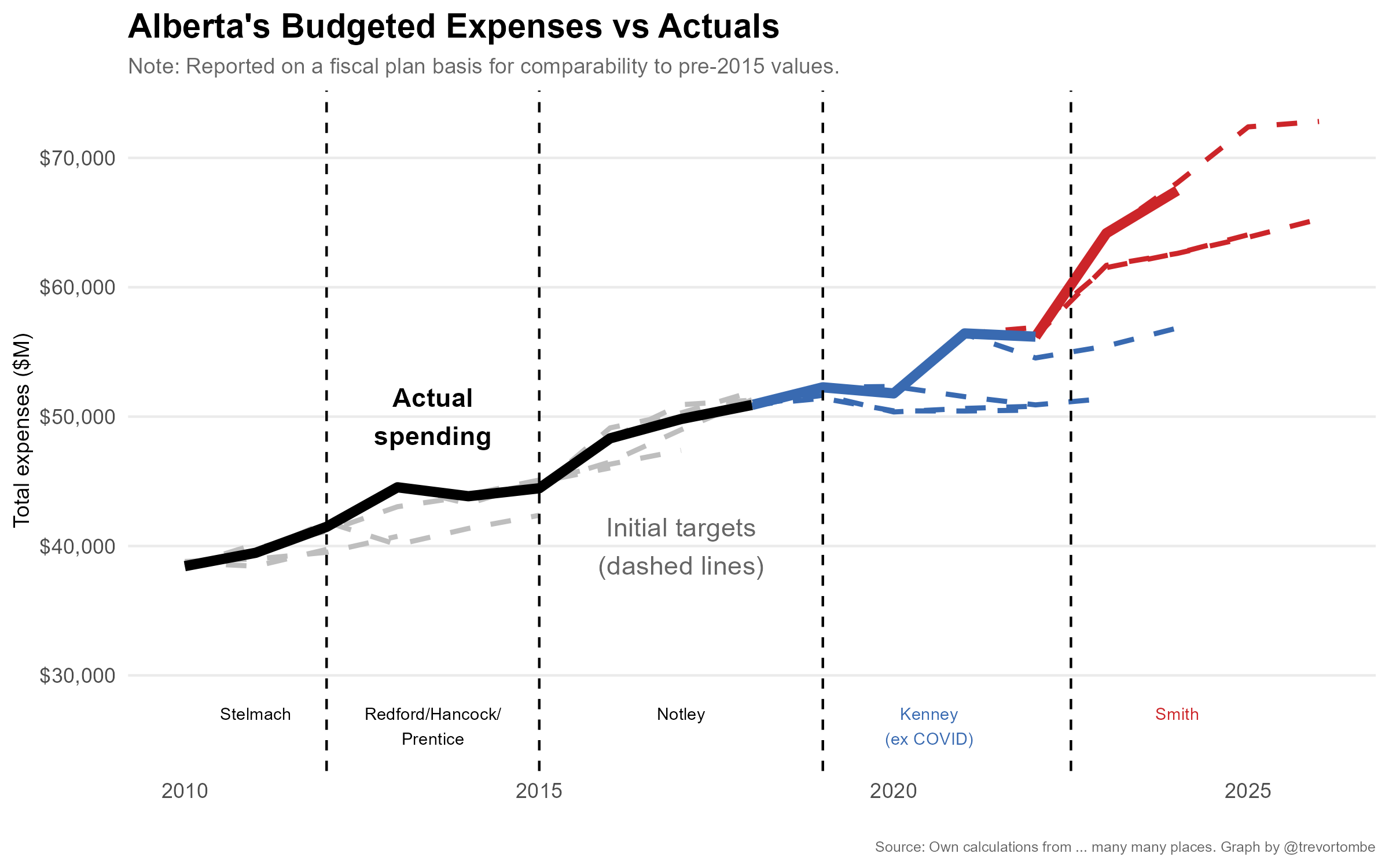
He also noted the UCP government’s habit of budgeting for lower expenditures, then spending much more than planned: “Spending has ratcheted up significantly in recent years (even adj. for prices and pop), even above govt's own targets.”
What’s driving Alberta oil expansion plans?
“Our economy is fuelled by our responsibly produced oil and gas, and the global demand has never been higher or more important.” - Brian Jean, Minister of Energy and Minerals, Alberta government press release, Feb. 26
Smith has made no secret of her ambition to grow Alberta oil production, which currently sits at about 4 million barrels per day. All of that growth will come from the oil sands. Conventional production will average between 500 and 600,000 barrels per day between now and 2030, while bitumen extraction is expected to grow another half million barrels per day. Canada is already the largest heavy sour crude producer in the world. Within North America, it is the most competitive barrel available to refineries. But in Asia and Europe, where transportation costs are much higher, it is more often than not a marginal barrel, meaning it needs tight supply and high oil prices to find a buyer.
Smith has tasked Jean with figuring out how to double oil production while somehow having five (yes, Reader, you read that correctly) new pipelines built to all corners of the map. Prime Minister Mark Carney has held out the possibility of a 1.3 million barrels per day heavy sour crude oil pipeline to the West Coast. He has also mused about a pipeline to Churchill, Manitoba and the Arctic, as well as discussed reviving the Keystone XL project with President Donald Trump.
Cui Bono?
Who benefits from that frantic growth? Shareholders of the big oil sands companies are an obvious one. The best guess is that 50% to 75% of the shareholders of those corporations are foreigners, most of whom would be Americans.
Expanding production would require a great deal of capital to finance construction. That would benefit local manufacturing and service firms, as it has in the past. The great oil sands expansion between 2005 and 2015 was not so much a typical oil boom as it was a construction boom. Extracting bitumen is not like pumping conventional crude oil. The oil sands require large processing facilities and significant infrastructure, all of which took plenty of labour and materials. Once the plant is built, then capital expenditures fall dramatically, as they did after 2015.
The Alberta business community’s support for oil sands and pipeline expansion isn’t hard to understand. But workers have fared quite differently over the past decade. Provincial oil and gas employment peaked in late 2013 at just under 180,000, fell to 120,000 within a few years, then bounced up to 140,000 and back down ever since. During the same time, oil production rose by 40%.
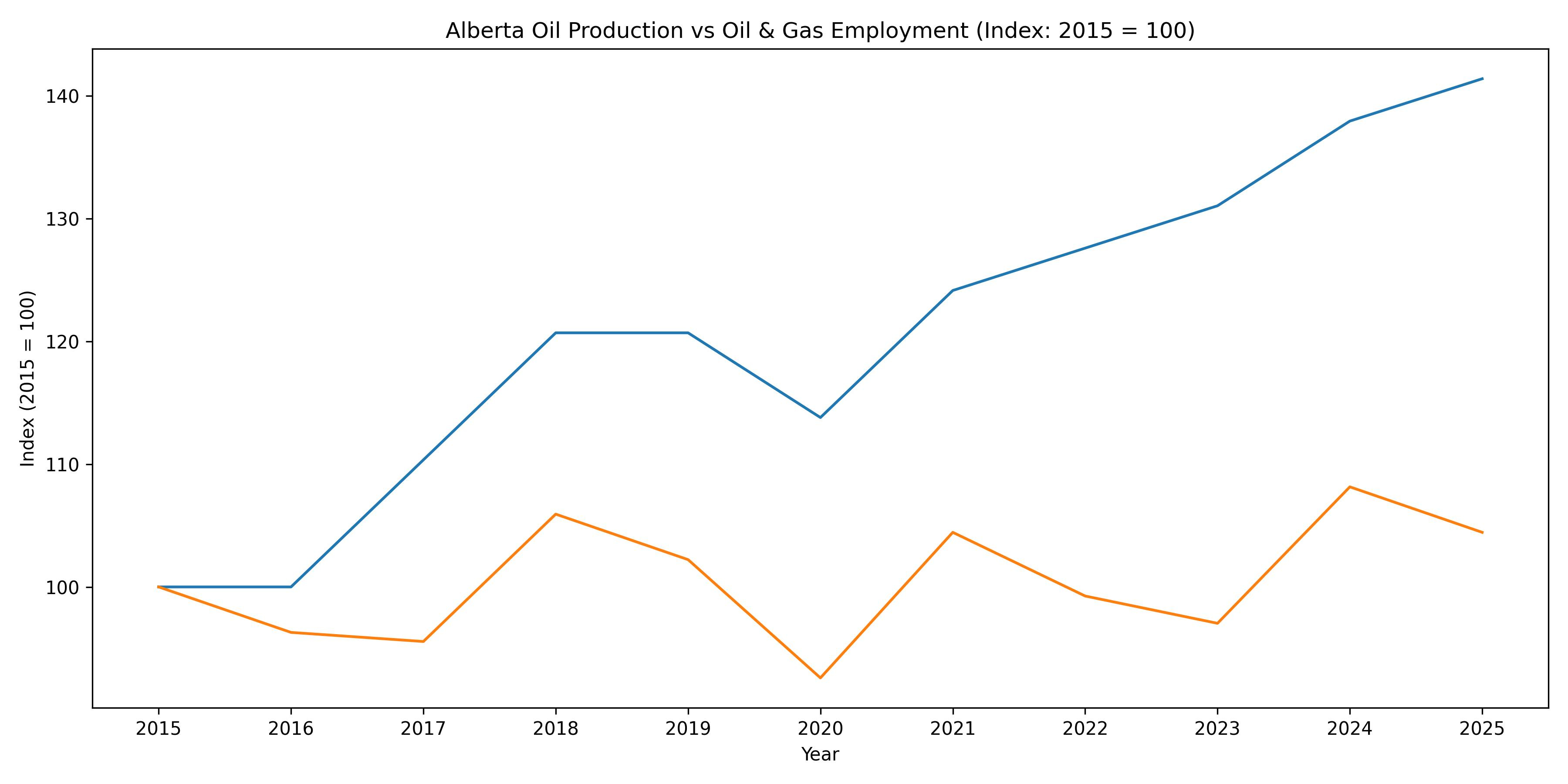
The forecast for the foreseeable future is for the industry to adopt ever more labour-saving technology, like automation and remote sensing and data analytics. More production no longer means an automatic boost in jobs. Whatever new employment would be created by expansion is likely to be short-term construction work, which is nothing to be sneezed at, but still not in the same league as the Alberta government claims.
All in all, Smith and her UCP government will be a major beneficiary of new oil sands production and any pipeline additions. Not right away, of course. Capital expenditures will have to be paid out before the higher royalty rate kicks in. Nevertheless, for a government now addicted to non-renewable oil and gas royalties, the allure of adding more revenue is not hard to understand.
The Upshot?
How much weight should we assign to the pursuit of government revenue as a motive behind Danielle Smith’s oil expansion plans?
A great deal.
Strip away the rhetoric about global demand and responsible production and what remains is a government confronting a structural dilemma. Alberta just experienced one of the largest royalty windfalls in its history. It still faces a $9.4 billion deficit. Spending has climbed. Expectations have hardened. Public services are under strain. And the province remains deeply reliant on a revenue source that swings wildly with global oil prices.
In that context, expanding production is not merely an economic strategy. It is fiscal insurance.
More barrels mean a larger royalty base. A larger royalty base means greater upside when prices rise. Even if employment doesn’t surge and even if much of the shareholder return flows outside the province, the provincial treasury stands to gain when volumes increase and price differentials narrow. For a government unwilling to raise taxes and reluctant to impose sustained spending restraint, production growth becomes the path of least political resistance.
But there is risk embedded in that choice.
Global oil markets are tightening and loosening in response to forces Alberta does not control: OPEC policy, U.S. shale responsiveness, Asian demand growth, energy transition policies, technological substitution. Adding supply into a market that may be structurally changing is not a guaranteed fiscal cure. It is a leveraged bet.
And there is a second reality.
The productivity data tell a blunt story: production can rise sharply without restoring the employment levels of the past decade. Automation, digitization and capital-intensive extraction have permanently altered the labour equation. The promise that “more oil equals more jobs” no longer holds as it once did. At best, expansion brings construction spikes and localized activity. The long-term employment base remains leaner than during the last boom.
So yes, revenue is a powerful motive. Perhaps the dominant one.
But chasing more oil revenue is not the same thing as building fiscal stability. It is doubling down on the same volatile foundation that has defined Alberta’s political economy for decades. If the boom years can still produce deficits, the deeper problem is not production levels. It is the structure of the province’s finances.
The question is not whether Alberta can produce more oil. It can. The question is whether producing more oil solves the problem Alberta is actually trying to fix.
Producing more oil will not fix the structural problems of dependence on resource revenue to fund government. Commodities are inherently cyclical and come with unpredictable price cycles. Diversifying the economy of Alberta and creating stable funding through taxation is the way to fix this problem. Which is why it will never happen.
If we funnelled resources revenue into the heritage fund, we could use the interest as a stable revenue to support government spending.
Then again that would require long term thinking.
UCP Deficit 2026 Announced
The United Conservative Party (UCP) government announced a $9.4 billion deficit for Alberta’s 2026 fiscal year, marking the largest deficit since the COVID-19 era and breaking the province’s own fiscal rules. This deficit is attributed to lower-than-expected oil prices, rising population-driven costs, and increased spending in health and education. The government projects three consecutive deficits totaling nearly $24 billion, with deficits of $7.6 billion in 2027 and $6.9 billion in 2028, pushing provincial debt to an estimated $137.5 billion by 2029. Despite the deficit, the UCP maintains its commitment to no major tax hikes or cuts to core services, citing affordability concerns and a desire to protect low taxes, which remain the lowest in Canada. Finance Minister Nate Horner acknowledged the fiscal framework has been breached, stating the government must find new rules that allow flexibility while still restraining spending.
Smith/UCP must go!