
Danielle Smith Is Not Not a Fascist
Smith doesn't fit the classic historical definition of a fascist but her political ideology, authoritarian libertarianism, is a close cousin

Energi Media journalism in video, audio, and essays
YouTube Channel: Video energy news
Substack Essays: Thoughtful Energy Journalism
Energi Talks Audio Podcast
Website: Energy news
“Fuck your fascist pancakes!” - A protester (Mikayla Resists on social media) who shouted at Danielle Smith as security guards hustled her away from an Edmonton K-Days event. The video ignited a firestorm of controversy on social media.
Is Danielle Smith a fascist? Well, what is a fascist these days? A 21st century Benito Mussolini or Adolph Hitler? Or just someone whose politics we don’t like? A big “no” to both questions. After watching her ideological evolution for decades, political scientist Duane Bratt now describes her as an authoritarian libertarian: Talks about freedom, governs like an authoritarian. Is that a form of fascism?
Yes. Fascism-lite or fascism-adjacent, if you like.
What Professor Robert Paxton Teaches Us About Fascism
The woman shouting “Fuck your fascist pancakes” at Danielle Smith asked a provocative question, but before we can answer it we need to know what fascism actually is. That is the approach taken by columnist Dan Gardner in his essay, Is It Fascism?
Rather than relying on popular stereotypes or historical analogies, Gardner turns to Robert Paxton’s classic The Anatomy of Fascism. Paxton rejected attempts to define fascism by ideology because fascists rarely possess a coherent ideology. Instead, he examined how fascist movements behave in practice.
His definition emphasizes recurring patterns: grievance and victimhood, nationalism (provincialism, in Smith’s case), contempt for liberal democratic institutions, the elevation of strong leaders over constitutional restraints, and a willingness to abandon democratic norms in pursuit of political objectives. Gardner then asks a straightforward question: does Donald Trump fit Paxton’s framework?
His answer, echoing Paxton’s own conclusion after January 6, is yes.
Does Danielle Smith Fit Paxton’s Definition?
Applying Paxton’s framework to Danielle Smith produces a more complicated answer.
Alberta politics certainly contains many of the ingredients Paxton identified. Smith routinely frames Alberta as the victim of Ottawa, federal institutions and hostile elites. She encourages a politics of grievance, distrusts independent institutions, and increasingly concentrates power in the Premier’s Office. Her government’s attacks on judges, municipalities, Alberta Health Services and, most recently, the independent electoral boundaries process all reflect a growing antagonism to institutional checks on executive power.
Professor Duane Bratt argues that proposed changes to Alberta’s electoral boundaries strike at “the fundamental nature of our democracy,” comparing aspects of Smith’s approach to tactics used by Viktor Orbán’s Hungary, Texas and Florida. Keep in mind that Smith is a big fan of Florida governor Ron DeSantis.
Yet important elements of Paxton’s definition are absent. Smith has not advocated political violence, suspended elections, created a mass militant movement or sought to dismantle parliamentary democracy. She resembles a leader moving toward authoritarianism, but she does yet not cross Paxton’s threshold into fascism.
The Better Description: Authoritarian Libertarianism
If fascism is not quite the right label, what is? Duane Bratt argues that Danielle Smith is better understood as an authoritarian libertarian: a politician who talks like a libertarian, but governs like an authoritarian.
My simpler version comes from Henry Ford, who said that customers could buy their cars in any colour they wanted as long as it was black. Well, Albertans can have as much freedom as they want as long as they agree with Smith and her government. If they don’t, then she is happy to strip transgendered kids of their rights or use the Notwithstanding Clause to break a teacher’s strike or gerrymander constituency boundaries to remain in power.
The contradiction is only apparent.
Smith continues to speak the language of freedom, limited government, and individual liberty, yet repeatedly uses the machinery of the state to reward allies, punish opponents, and weaken institutions that limit executive power. Bratt points to her conflicts with municipalities, Alberta Health Services, the courts and now the electoral boundaries process as evidence that libertarian rhetoric increasingly masks authoritarian practice.
That diagnosis also explains why Smith’s politics so closely resemble Donald Trump’s. Both invoke freedom while centralizing authority, both cultivate narratives of victimhood, and both portray institutional constraints as obstacles rather than safeguards of democracy.
Smith may not be a classic fascist, but she occupies political territory immediately adjacent to it.
Attacking the Messenger
A surprising twist in the “fuck your fascist pancakes” controversy comes courtesy of two senior Alberta conservatives, former premier Jason Kenney and Smith’s chief political strategist Rob Anderson.
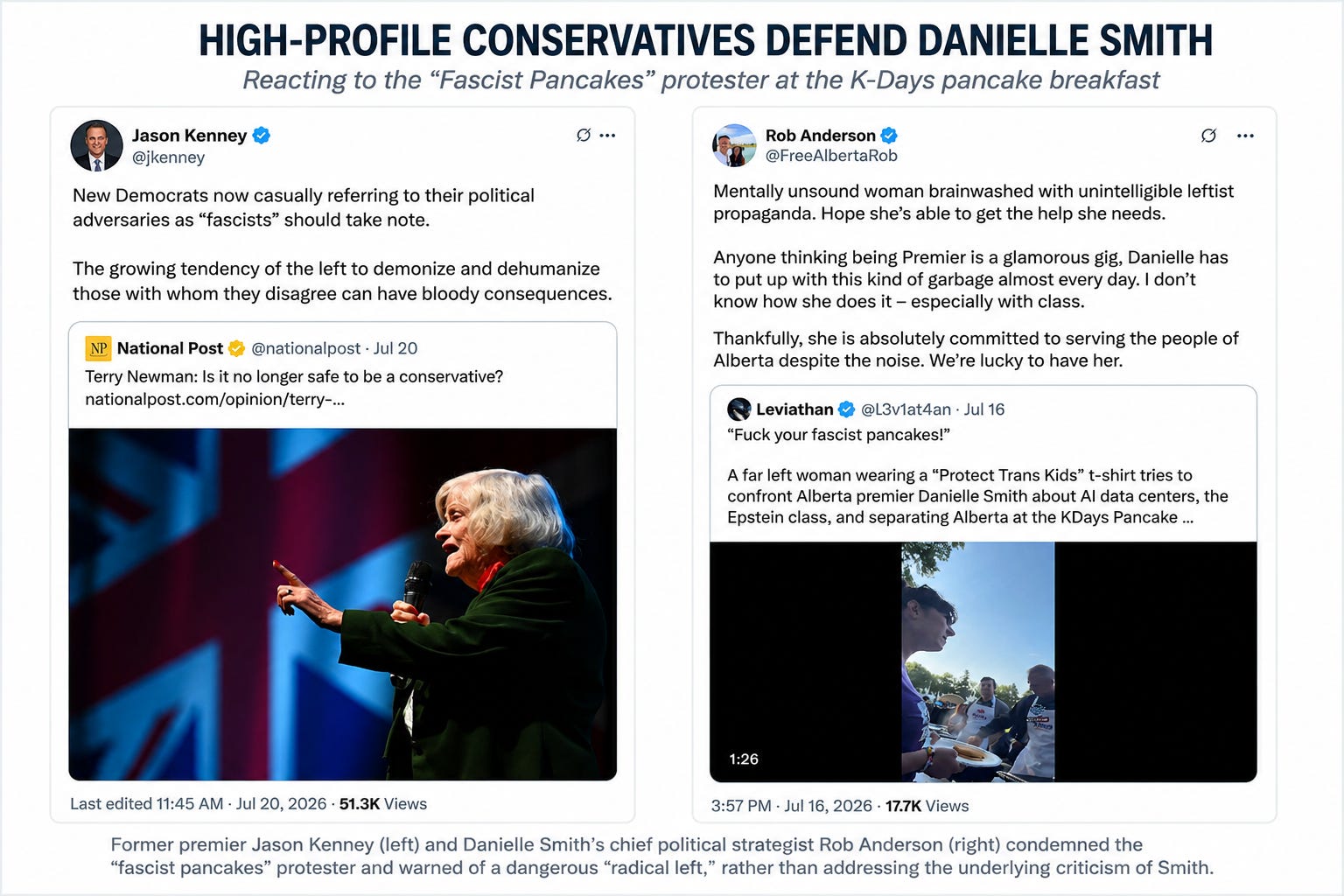
Both ignored the substantive question raised by the pancake protest and focused instead on condemning the protester’s language and motives. Anderson’s response to Bratt on social media followed the same pattern, dismissing him as a partisan rather than engaging with his argument about democratic institutions.
These are classic ad hominem attacks. They shift attention away from evidence and toward the character of the critic. The result is that the public debate becomes about civility, outrage and political theatre instead of whether Alberta’s governing style is becoming more authoritarian.
Saying Smith is Not Not a Fascist is Damning with VERY Faint Praise
Danielle Smith does not satisfy Robert Paxton’s definition of fascism. She has not crossed the historical line that separates authoritarian politics from fascist politics. But neither is she a conventional libertarian committed to limited government, institutional restraint, and liberal democratic norms.
Duane Bratt’s description of her as an authoritarian libertarian is both more precise and more useful. It captures a governing style that borrows heavily from the politics of Donald Trump without fully reproducing it. The greater danger is that powerful defenders like Rob Anderson and Jason Kenney encourage Albertans not to examine that reality but to dismiss anyone who points it out.
The pancake protester got the label wrong, but she identified something real. Now it’s time to call that something what it really is. Danielle Smith may not be a full-blown fascist—yet—but she’s close enough that Albertans should be very worried.
And any politician, past or present, who defends her should be roundly criticized.
NOTE: I incorrectly identified the Calgary Stampede as the location of the Premier’s public event. In fact, it was Edmonton. The essay has been corrected.
Call her what you will. Fascist, fascist adjacent, libertarian- it doesn’t matter.
Let’s name it for what it is. She’s a self serving soulless leader looking for the spotlight and to be adjacent to the wealthy. She will do or say anything to stay there.
Let’s also be clear that this woman, the party she leads and the hangers on she attracts are detrimental to the well being of this province, its institutions, its environment, its people and its future.
So to Mikala resists - well done. If FYFP is what it takes…
Regarding political violence, Smith’s legislation encourages that violence. Her silence on specific matters endorses violence. One can “advocate” in many ways, but there is no question in my mind that in fact she creates the conditions for political violence to take place. She might have cleverly inverted the pattern, but it’s still present.