
Wrangling Smith and Ford: Carney's National Power Grid Challenge
Is the Prime Minister up to the task of surmounting the politics that comes with getting the provinces to cooperate

Energi Media journalism in video, audio, and essays
YouTube Channel: Video energy news
Substack Essays: Thoughtful Energy Journalism
Energi Talks Audio Podcast
Website: Energy news
In mid-May, Prime Minister Mark Carney released his government’s National Electricity Strategy. One of its key proposals is linking Canada’s provincial power grids into one—or perhaps several—east-west electricity systems using transmission interties. Last Friday, Ottawa took an important step toward that goal by announcing support for five priority intertie projects. The projects are intended to become the backbone of a more integrated national electricity system capable of supporting Canada’s electrification strategy. One of them, between British Columbia and Alberta, illustrates the types of difficulties that may bedevil the idea of a national power grid.
The BC-Alberta experience suggests that Canada’s greatest obstacle is not engineering or financing but governance. Building a national electricity grid is ultimately a political challenge, not a technical one. Ottawa must find ways to align provincial interests, utilities, system operators and regulators behind common objectives.
That is much easier said than done. And Carney must not make the same mistakes as his predecessor, Justin Trudeau.
Trudeau repeatedly argued that a more integrated national grid would improve reliability, reduce emissions and unlock Canada’s clean electricity advantage. He backed that vision with billions of dollars through programs such as the Smart Renewables and Electrification Pathways Program and the Canada Infrastructure Bank. More targeted funding was provided for strategic interties such as the proposed Atlantic Loop.
Yet while Ottawa was willing to provide financing, it proved far less successful at overcoming the political and institutional barriers that ultimately determine whether interties get built.
The federal government generally left provinces and their utilities to negotiate among themselves, investing relatively little political capital in resolving disputes or forging binding agreements. As a result, progress was uneven. A handful of regional projects moved forward, but the broader ambition of a more interconnected national electricity grid remained largely unrealized, leaving the Carney government to revive a nation-building project that is still more aspiration than accomplishment.
The BC-Alberta dispute illustrates what can go wrong if Carney and Energy Minister Tim Hodgson are unable to overcome the political challenges that lie ahead.
Provinces Trade Electricity with US States, Not Other Provinces
Electricity is a provincial responsibility, with mostly government-owned utilities designed to serve domestic ratepayers first and export surplus power where profitable. The result is a fragmented Canadian electricity map of 13 “islanded” grids that trade more easily with U.S. states than with each other. Large hydro provinces such as British Columbia, Manitoba, Quebec and Newfoundland and Labrador built transmission links to U.S. customers who were often closer, larger and more commercially attractive than neighbouring Canadian provinces.
For much of the past century, that arrangement made perfect economic sense. Today, however, it poses a challenge. Stronger east-west connections could improve reliability, lower costs and support the electrification of the Canadian economy, yet the country’s electricity infrastructure remains oriented north-south. That legacy now sits directly in the path of Ottawa’s ambition to build a more integrated national grid.
East-West Interties are Central to Canada’s Electrification Strategy
As demand surges from artificial intelligence, data centres, electric vehicles, mining, manufacturing and building electrification, stronger interties allow provinces to share surplus power, reduce the need for expensive backup generation while improving grid reliability and lowering overall system costs. They also make it easier to integrate renewable energy by balancing variable wind and solar resources over larger geographic areas.
Recognizing these benefits, the Carney government has identified five priority intertie projects: the Yukon-British Columbia Grid Connect, the British Columbia-Alberta intertie, the Saskatchewan-Manitoba intertie, the Ontario-Quebec intertie, and the Wasoqonatl Reliability Intertie between New Brunswick and Nova Scotia. Together, they are intended to form the backbone of a more integrated national electricity system capable of supporting Canada’s economic growth and electrification.
The BC-Alberta Intertie is Canada’s Cautionary Tale
The main 500-kilovolt Cranbrook-Langdon transmission line was completed in 1986. It is the backbone of the BC-Alberta intertie, though the broader intertie also includes two smaller lines crossing near Sparwood and Elkford. The intertie connected two provinces with highly complementary electricity systems, a relationship that has become even more valuable as Canada’s electricity sector has evolved.
British Columbia relies primarily on large hydroelectric reservoirs that can store energy for weeks or months, making them ideal for balancing intermittent renewable generation. Alberta, by contrast, operates a competitive electricity market that has transitioned from coal to a system dominated by natural gas, with rapidly growing wind and solar generation. Because hydroelectric reservoirs can quickly increase or decrease output, they provide exactly the kind of flexible, dispatchable electricity that complements Alberta’s increasingly variable electricity supply.
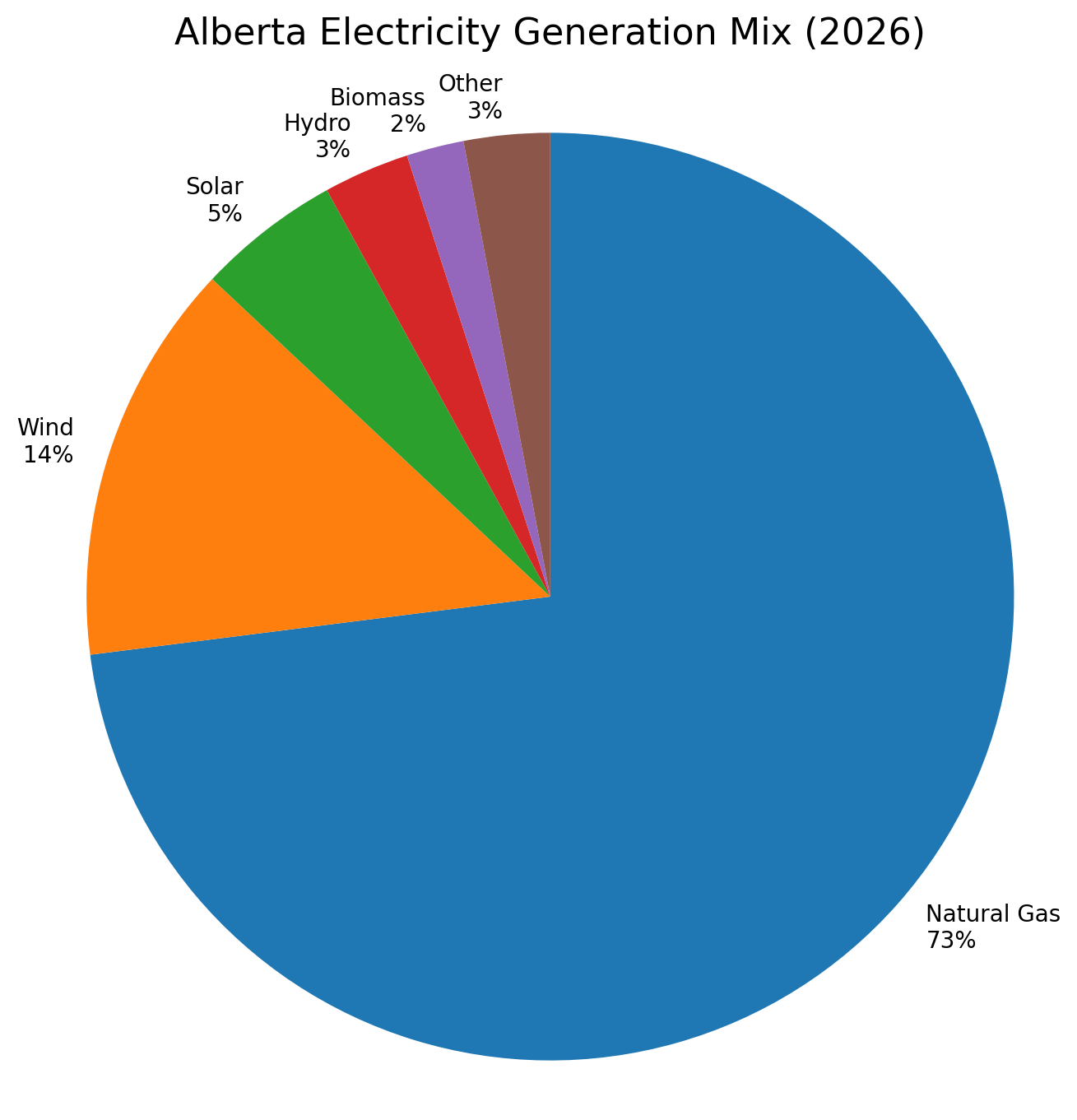
A stronger intertie would allow Alberta to import clean hydroelectric power during periods of high demand or low renewable output, while giving British Columbia greater access to Alberta’s market when surplus electricity is available. On paper, the arrangement offers significant benefits to both provinces. Yet after nearly two decades of regulatory disputes, those benefits remain largely theoretical. Instead of becoming a model for interprovincial cooperation, the intertie has become a case study in how institutional barriers can overwhelm economic logic.
The dispute stems from the way Alberta manages reliability on its electricity grid.
During periods of high demand or system stress, the Alberta Electric System Operator (AESO) has increasingly reserved a significant portion of the BC-Alberta intertie for emergency reliability services rather than commercial electricity imports. Every megawatt reserved for reliability is one less megawatt available for commercial electricity trade. British Columbia argues this effectively throttles the amount of hydroelectricity it can sell into Alberta’s market, reducing commercial import capability to a fraction of the transmission line’s physical capacity.
From British Columbia’s perspective, Alberta receives the reliability benefits of being connected to BC’s hydro system without providing the reciprocal commercial access the intertie was designed to support.
Alberta’s position is that the restrictions are necessary to maintain the reliability of an electricity system that now depends heavily on natural gas generation and a rapidly growing share of intermittent wind and solar resources. Because Alberta’s grid has relatively little energy storage, system operators need the flexibility to respond instantly when a generator trips offline or renewable output suddenly falls. Reserving transmission capacity for emergencies is one way to provide that flexibility.
British Columbia counters that Alberta should instead invest in additional reliability resources—including batteries, fast-frequency response technologies and other ancillary services—rather than using the intertie as a substitute for those investments. Until Alberta develops enough domestic flexibility to reduce its reliance on the intertie for reliability, BC argues, meaningful commercial electricity trade between the two provinces will remain constrained.
The most remarkable aspect of the BC-Alberta dispute is its longevity. In 2007, Alberta amended its Transmission Regulation to require restoration of the intertie’s import capability, reflecting the province’s recognition that stronger electricity trade with British Columbia served the public interest. Yet nearly two decades later, the issue remains unresolved.
Whether or not BC’s diagnosis is entirely correct, the fact remains that a problem identified in 2007 still lacks a solution in 2026. It is a sobering reminder that governance failures, not engineering challenges, can delay projects that appear to offer clear economic benefits to both provinces.
The Lesson for Ottawa is Simple and Sobering
If two neighbouring provinces with complementary electricity systems cannot resolve a dispute over a single strategically important intertie, building a national network of interconnected provincial grids will require much more than federal funding. It will require sustained political leadership, effective institutions and governance mechanisms capable of aligning the interests of provinces, utilities, regulators and system operators.
Otherwise, today’s five priority interties could become tomorrow’s five unresolved disputes.
Can the Prime Minister provide that kind of leadership? Can Energy Minister Tim Hodgson?
Thus far, the Liberal government has responded to a more hostile United States and a fracturing post-1945 rules-based international order by unveiling an ambitious series of national strategies, including electricity, automotive manufacturing, nuclear energy and defence. It has also negotiated memoranda of understanding with provinces and pursued measures to strengthen internal trade. Rather than announcing isolated programs, Carney is attempting to reshape the Canadian economy through coordinated strategies intended to reinforce one another. Critical minerals feed the automotive and battery sectors. Electricity powers AI, manufacturing and electrification. Internal trade and major projects are intended to accelerate development across all of those sectors.
Soon, however, strategy will give way to implementation. At that point, the rubber will meet the road. Canadians will discover whether the government can translate ambitious plans into tangible results.
The National Electricity Strategy does not depend on whether Canada knows how to build transmission lines. It depends on whether governments can work together long enough to build them. The BC-Alberta intertie demonstrates just how difficult that task can be.
If Carney can succeed where previous governments have struggled, his vision of a more integrated national electricity grid may finally become a reality.
Endnotes:
Natural Resources Canada. “Canada Takes Action to Advance a Stronger Grid and Increase Reliable, Affordable Energy.” Government of Canada, June 26, 2026. https://www.canada.ca/en/natural-resources-canada/news/2026/06/canada-takes-action-to-advance-a-stronger-grid-and-increase-reliable-affordable-energy.html
Natural Resources Canada. “Powering Canada Strong: National Strategy for an Electrified Canadian Economy.” Government of Canada. https://natural-resources.canada.ca/energy-sources/electricity-infrastructure/powering-canada-strong-national-strategy-electrified-canadian-economy
Clean Energy Canada. “Response: Federal Interprovincial Transmission Announcement is a Win for Everyone and Our Electrified Future.” June 2026. https://cleanenergycanada.org/response-federal-interprovincial-transmission-announcement-is-a-win-for-everyone-and-our-electrified-future/
Pembina Institute. “Announcement of Five Priority Intertie Projects is the Latest Major Step Forward in Building Canada’s Electricity Grid.” June 2026. https://www.pembina.org/media-release/announcement-five-priority-intertie-projects-latest-major-step-forward-building
EnergyRates.ca. “What is an Intertie and Why Does it Matter in Alberta?” https://energyrates.ca/what-is-an-intertie-and-why-does-it-matter-in-alberta/
Government of Alberta. Transmission Regulation, Alta Reg 86/2007. CanLII. https://www.canlii.org/en/ab/laws/regu/alta-reg-86-2007/latest/alta-reg-86-2007.html
AESO. “Fast Frequency Response Plus.” Alberta Electric System Operator. https://aesoengage.aeso.ca/fast-frequency-response-plus
Energy Policy. “Interprovincial Electricity Transmission in Canada: Governance, Institutions and Electricity Market Integration.” Energy Policy, 2025. https://www.sciencedirect.com/science/article/pii/S0301421525003283
Business in Vancouver. “Failed BC-Alberta Transmission Line Holds Lessons for a National Grid.” June 2026. https://www.biv.com/news/resources-agriculture/failed-bc-alberta-transmission-line-holds-lessons-for-a-national-grid-10725383
Government of Canada. Smart Renewables and Electrification Pathways Program (SREPs). https://natural-resources.canada.ca/climate-change/green-infrastructure-programs/smart-renewables-and-electrification-pathways-program
Canada Infrastructure Bank. “Atlantic Loop.” https://cib-bic.ca/en/projects/clean-power/atlantic-loop/
Canada Energy Regulator. “Provincial and Territorial Energy Profiles: Alberta.” (Background data on Alberta’s electricity generation mix and market.)
https://www.cer-rec.gc.ca/
Markham a good summary thanks.
The provinces have to get their heads out of their butts and get on the program. I think a number of them have made good efforts last year, but so far this year it has been crickets on progress for removing inter-provincial barriers. The MOUs with the feds should include requirements for dismantling barriers and timelines.
And Canadians writ large need to step up loudly to support this. Write letters to Premiers and others regularly. Demand that these initiatives happen at speed.
Our PM is not God. He can’t wave a wand like some Canadians seem to expect. I’ve seen a lot of commentary criticizing him. It makes me furious. He is the best PM in my lifetime. Under brutal circumstances.
We need to get involved in these plans. It’s our responsibility.
And mainstream media needs to also get out of the way. Fact check and report on the issues Canadians care most about. They have done an appalling job the past couple years. Thankfully independent media is rising.
Very interesting and informative, Markham. From just this discussion of the Alberta-BC intertie agreements and the longevity of the disputes, and I suspect that in other areas of the country both in this electification plans as well as other areas like interprovincial Trade it is really not Ottawa that is the problem. Under our Confederation Constitution, the BNA Act of 1867, deliniated federal and provincial responsibilitie. We must remember that was over a century ago. Four main colonies had been somewhat unified through various Acts of the British Parliament. The division of responsibilities in S. 92 and 93 likely made very good sense at the time. It seems that provinces hold those sections as if they are the Holy Grail of their identity. It seems those divisions of responsibility or powers if you will, have never been amended over all this time. We still have Premiers at times, and one in particular all the time, saying Ottawa is infringing on their provinces authority. Alberta's constant whining about pipelines is a fair example. They blame Ottawa for the BC governments not jumping on board. But if Alberta just stopped all the BS and talked turkey with BC then something might actually happen. I understand the national interest issue Ottawa has in safeguarding the environment and respecting any Indigenous treaties or commitments and the way federal laws at times actually do conflict with this whole concept of interprovincial 'trade' and cooperation.
Could it be that Ottawa is not really the problem? Could it be that Provincial Premiers see their respective province as their personal -- party -- little firedom? These premiers have regular meeting and yet we have not seen much movement in the interprovincial cooperation about anything. The provinces blame Ottawa for the issues they themselves could resolve IF they stop the politicking and get on with governing. Just a thought.