
EU's Electrification Plan Shows Canada How It's Done
Europe plans to electrify its economy by 2050, while Canada talks a good game but is likely to make little progress

Energi Media journalism in video, audio, and essays
YouTube Channel: Video energy news
Substack Essays: Thoughtful Energy Journalism
Energi Talks Audio Podcast
Website: Energy news
"Over the coming decades, Canadians will use more electricity because many of the things we use every day – the cars we drive, the heaters in our homes, and the machines in our factories – are switching to electric power." - Prime Minister Mark Carney speech, May 14, 2026
The European Union’s Electrification Action Plan, released last week, is about deciding what kind of economy Europe intends to build over the next quarter-century. Its argument is simple but profound: the countries that organize themselves around electricity will build the strongest economies of the twenty-first century.
Electrification is not just a plan for expanding the power grid. It is the organizing principle for Europe’s industrial economy, its energy security, its investment strategy and its response to intensifying economic competition from China and the United States.
Canada’s National Electricity Strategy, released in May, begins from much the same diagnosis. Electricity will supply a growing share of the energy used in transportation, buildings and industry. Demand could double by 2050. Generation, transmission and distribution will have to expand rapidly. Carney has distilled the argument into a compelling formula: the path to affordability, competitiveness, and net-zero is electrification.
The difference is what happens after that declaration.
Europe asks how the state can accelerate demand for electric technologies, create the industries that supply them, mobilize capital, train workers, strengthen grids and hold governments accountable for delivery. Canada concentrates on the electricity system itself and largely assumes that the wider economic transformation will emerge as households and businesses make increasingly attractive market choices.
Canada has a vision of an electrified future. Europe has a plan for building one. The likely consequence of that difference is that Canada arrives at mid-century with an economy still relying on electricity for just a quarter of its energy. At the same time, Europe will be far more electrified, perhaps by twice as much.
If the EU is correct about electrification, then Canada will be at a serious economic disadvantage.
Consider that the electrification of several Asian countries (China, South Korea, Japan) is 30 per cent or more, and the pace of electrification is rapidly ramping up in other parts of Asia, and Canada’s problem becomes more dire. Other Global South competitors (e.g. Brazil, Saudi Arabia, Chile, South Africa and Morocco) are also pursuing aggressive electrification.
Canada's Economy Is Dirty, Not Clean—and It's Getting Dirtier

Energi Media journalism in video, audio, and essays
Shared Vision, Shared Starting Point
“Because the path to affordability is electrification. The path to competitiveness is electrification. The path to net-zero is electrification. Electrification underpins everything – our emissions, our environment, our economy.” - Carney speech
“Electricity consumption is now projected to grow at least 2.5 times faster than overall energy demand, hastening the world’s transition to an electricity-based economy.” The International Energy Agency
Canada and the European Union begin from similar starting points. Electricity currently provides roughly 23 per cent of final energy consumption in both economies. Both governments argue that this share must rise substantially as electric vehicles replace internal-combustion cars, heat pumps displace oil and natural gas heating, and industrial machinery shifts from combustion to electric power.
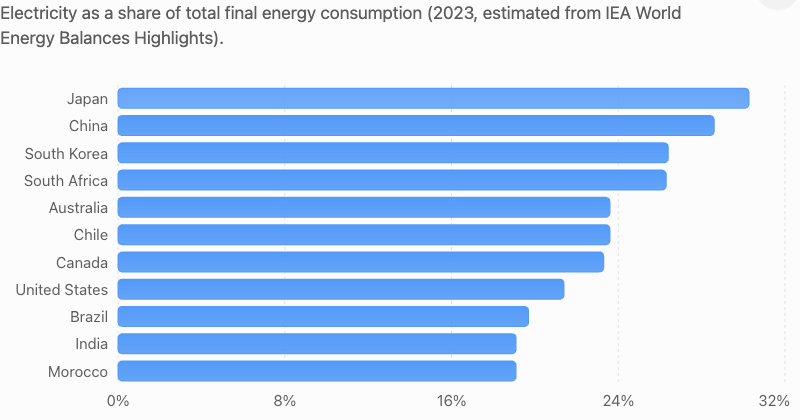
Both understand that this transition will require far more generation and a much larger grid. But the two strategies define the economic project differently.
Canada’s central problem is supply: how to produce and deliver enough electricity to satisfy demand as electrification proceeds. Europe’s central problem is coordination: how to make electrification happen faster while ensuring European companies, workers, and communities capture a larger share of the resulting economic value.
That distinction changes the questions each government asks. Canada asks where new power will come from, how provincial grids will connect and how projects can be approved more quickly. Europe asks those questions too, but then goes further. Which technologies should be manufactured in Europe? Which industries should receive priority access to clean power? How should public finance lower investment risk? What regulations will accelerate the replacement of fossil-fuel equipment? What skills will workers need? How should progress be measured?
The European strategy therefore treats electrification as a system of mutually reinforcing changes. More electric vehicles support battery manufacturing and charging networks. More heat pumps support equipment manufacturing, building retrofits and skilled trades. More industrial electrification supports grid investment, power contracts and new clean manufacturing.
Each policy expands the market for the others.
The Huge Hole in Carney's Canadian Electricity Strategy

Energi Media journalism in video, audio, and essays
What Theory of Change Underlies Each Strategy?
“In tandem, the relationship between electricity demand and economic growth is undergoing a paradigm shift. Traditionally, electricity use has closely tracked economic expansion, excluding periods of global financial crises. However, in a marked departure from the past, electricity demand is now expected to outpace economic growth on a global scale through 2030.” - The IEA
The two strategies begin from very different theories of change. In this context, a theory of change explains how governments believe a desired outcome will be achieved: which institutions must act, what policies must reinforce one another, where investment will come from, and how businesses and consumers will respond.
In this case, both Canada and Europe want electrification to become the foundation of their future economies. Their strategies differ in how they expect to get there, particularly in the roles assigned to governments, markets, public investment and industrial policy.
The European Union assumes that governments shape economies by setting a destination and then aligning public policy behind it. Markets are expected to innovate, invest and compete, but within a framework deliberately designed by governments.
Canada's strategy begins from a different premise. It assumes consumers and businesses will increasingly choose electric technologies because they make economic sense, while governments focus on ensuring there is enough electricity generation, transmission and distribution to meet growing demand.
Europe sees electrification as a government-led economic transformation. Canada sees it as a market transition that governments must facilitate.
European and Canadian Views of the State and Markets
The European Union and Canada also hold very different views about the role of the state in economic transformation.
The EU assumes governments must lead the transition by setting a destination and then aligning industrial policy, regulation, finance, workforce development and infrastructure behind it. Markets are expected to innovate and compete, but within a framework deliberately designed by public policy.
Canada assigns governments a narrower role. Its strategy assumes consumers and businesses will increasingly choose electric vehicles, heat pumps and industrial technologies because they make economic sense, while governments focus on expanding the electricity system needed to support those choices.
Europe sees the state as the architect of electrification. Canada sees it as the provider of the infrastructure that enables electrification.
Markets play an important role in both strategies, but they are expected to do different jobs.
The European Union views markets as the engine that delivers innovation, competition and private investment once governments have established the strategic direction. Public policy shapes the market; the market executes the strategy. ‘
Canada’s approach gives markets much greater responsibility. It assumes households and businesses will drive electrification by purchasing electric vehicles, heat pumps and industrial equipment when those technologies become more attractive than fossil-fuel alternatives. Governments’ primary task is to ensure sufficient electricity is available when those market decisions are made.
In Europe, markets are guided. In Canada, they are expected to lead.
Canadian Energy Conversation is Stuck in the Wrong Century

Energi Media journalism in video, audio, and essays
What Does Federalism Do to Canada’s Implementation Capacity?
Even if Ottawa were more ambitious, Canada’s constitutional division of powers leaves implementation largely in the hands of provincial governments that, with the notable exception of Quebec, have shown little interest in organizing their economies around electrification.
Electricity systems, natural resources, building codes, utility regulation and much of industrial policy fall within provincial jurisdiction, limiting the federal government’s ability to impose a unified national strategy. The result is a patchwork of priorities, policies and timelines that reflect provincial political choices rather than a shared national vision.
Quebec is the Canary for Canada's Electrification Strategy

Energi Media journalism in video, audio, and essays
The European Union also governs through multiple jurisdictions, but its member states have collectively agreed to pursue electrification as a common strategic objective.
Canada has no comparable political consensus, making coherent implementation far more difficult. Europe treats industrial policy as the mechanism of transformation, while Canada treats it as a collection of interventions, most of which are the responsibility of provincial governments over which it has no control.
Canada’s Place in the Global Electrification Race
Today, Canada sits comfortably in the middle of the international pack. Roughly one-quarter of its final energy consumption comes from electricity, placing it alongside other advanced economies such as Australia and still within striking distance of countries like Japan, China and South Korea.
The problem is not where Canada stands today, but where it appears to be heading. This is why the comparison to Europe is important.
The EU has committed to nearly doubling electricity’s share of final energy consumption by 2050 as it electrifies transportation, buildings and industry. China continues to expand electric vehicles, high-speed rail, electric industrial processes and ultra-high-voltage transmission at a pace unmatched anywhere else. Emerging economies like India, Brazil, Chile and Morocco are also investing heavily in electrification as a strategy for improving energy security, lowering costs, and building globally competitive industries.
If Canada simply maintains today’s trajectory, electricity will still account for only about one-quarter of final energy consumption in 2050 while other advanced and emerging economies move toward electrification rates approaching 40% or even 50%, Canada risks becoming an outlier, not because it lacks clean electricity, but because it failed to organize its economy around using it.
The country’s competitive challenge, therefore, is ensuring its clean electrons displace oil and gas throughout the economy.
That is the distinction this essay has tried to make. Canada’s National Electricity Strategy is a plan to expand the electricity supply. while letting markets determine demand. The European Commission’s Electrification Action Plan is a strategy to transform electricity demand, then create the supply to meet that increased demand.
By mid-century, that difference could mean the difference between a growing, globally competitive Canadian economy and one that struggles to keep pace.
Maybe it doesn't go far enough, but Carney's federal electricity-grid project is a good start. We can't go electric if we don't have the infrastructure.