
Canada's Got Future Energy Demand All Wrong
IEA data shows that clean electricity share of energy demand growth is now almost 60% - and its growing each year

Energi Media journalism in video, audio, and essays
YouTube Channel: Video energy news
Substack Essays: Thoughtful Energy Journalism
Energi Talks Audio Podcast
Website: Energy news
In an interview years ago, Kingsmill Bond told me that new energy technologies like solar and wind would increasingly take the growth in global energy demand, then fossil fuels would stop growing, followed by a gradual decline in their share of demand. New data from the International Energy Agency (IEA) suggests that the process is well underway. If Bond is correct, the implications are significant for Canada as it tries to become an “energy superpower.”
Oil and gas boosters, on the other hand, argue that future primary energy demand will look exactly like it did from 1945 to now (see graph below). New energy sources will be added to existing ones as emerging economies become middle class and buy autos, air conditioners, and other consumer goods. The world needs all forms of energy. There is no energy “transition,” just voracious consumption that never stops growing.
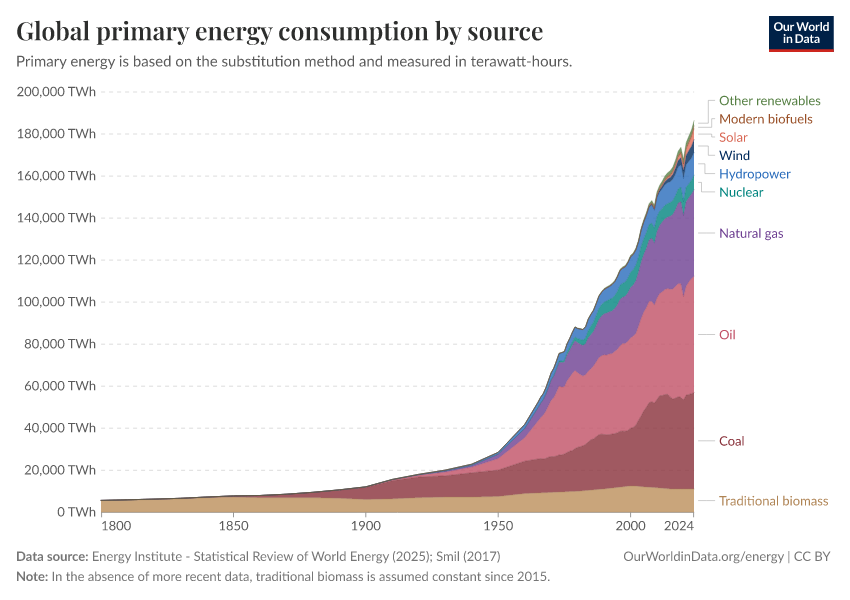
This is the Canadian view—very much influenced by the hydrocarbon industry in Alberta—of the energy future. And it underpins the economic strategy of Prime Minister Mark Carney’s government.
According to the IEA, that view is wrong.
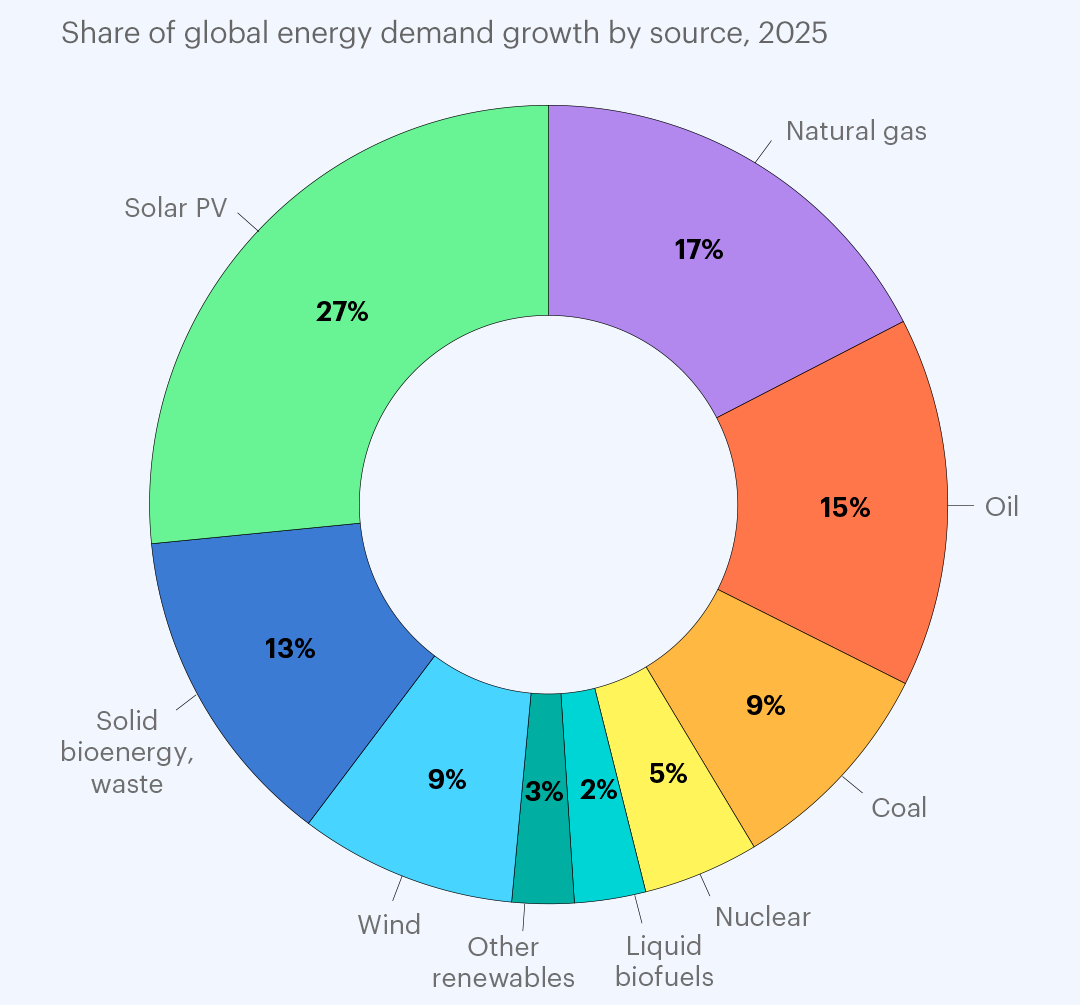
In 2025, every major fuel and technology expanded, yet solar power — not oil, gas or coal — supplied the largest share of new global energy demand for the first time on record. The IEA’s Global Energy Review 2026 shows that global energy demand rose 1.3 per cent last year and low-emissions energy sources now account for most new growth, even as fossil fuels continue to dominate the overall system.
Structural change to the global energy system is on the horizon and Canada should adjust its worldview accordingly.
Global Energy Demand is Still Met By a Wide Range of Sources
To be clear, the IEA is not arguing that fossil fuels are disappearing.
Global demand for oil, natural gas, and coal all increased in 2025, just at slower rates than in previous years. Fossil fuels still dominate the global energy system and continue to supply most electricity generation and industrial energy demand.
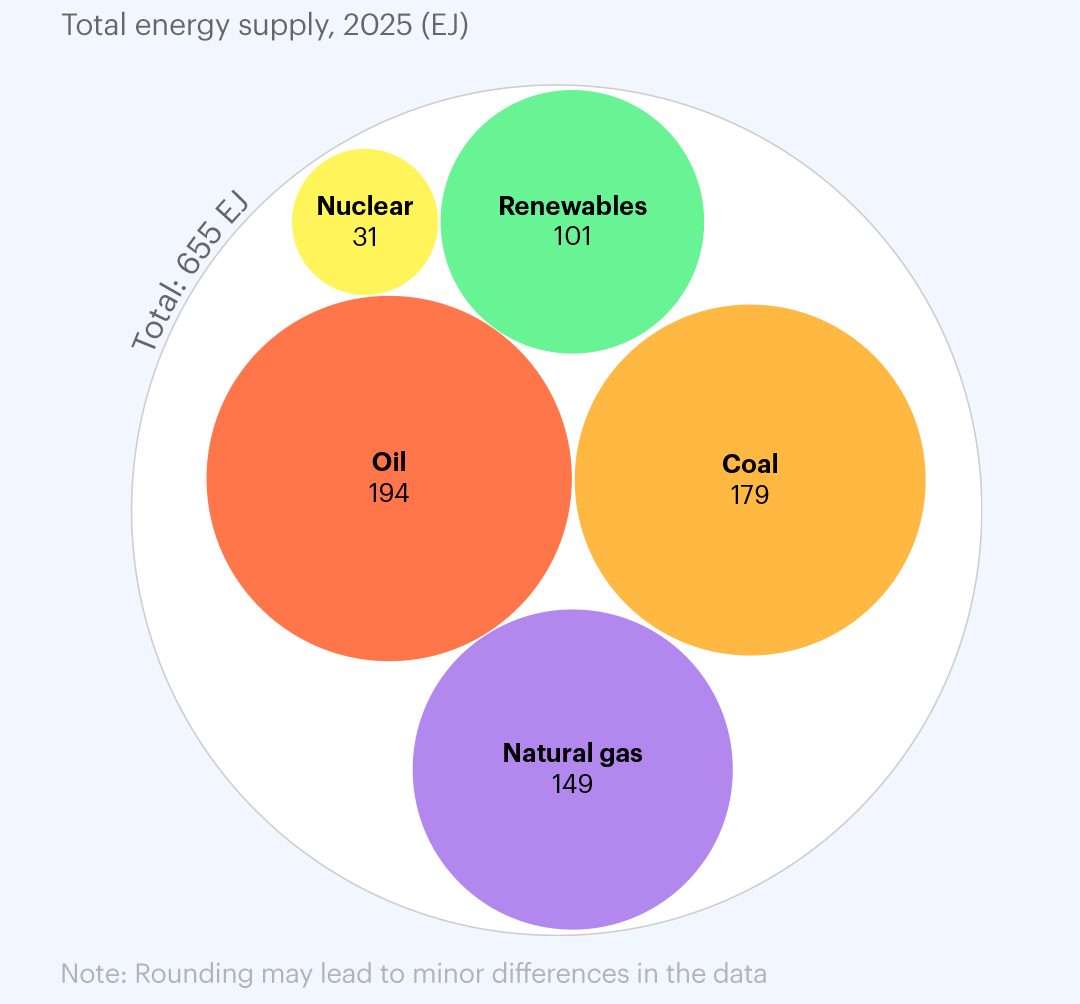
Natural gas accounted for 17 per cent of new energy demand growth last year, oil supplied 15 per cent, and coal another 9 per cent. But hydrocarbons are no longer automatically capturing most incremental growth.
Low-emissions energy sources met 59 per cent of growth.
Solar Supplied the Largest Share of Energy Demand Growth
Solar power emerged as the defining energy story of 2025.
The IEA says solar photovoltaic generation met more than one-quarter of all new global energy demand, the first time a modern renewable source has supplied the largest share of annual demand growth.
Solar generation increased by a record 600 terawatt-hours last year, the largest annual increase ever recorded for any electricity source outside of post-crisis (e.g. the Covid-19 pandemic) rebounds.
China remained the dominant growth market, but strong expansion also occurred in the United States, India, Europe and the Middle East.
Global solar capacity additions surpassed 600 gigawatts for the first time, reinforcing the technology’s position as the fastest-growing source of electricity generation in the world economy.
Global Electricity Generation Mix is Evolving
The global electricity system is now changing faster than the broader energy economy.
Electricity demand grew more than twice as fast as overall energy demand in 2025, driven by data centres, electrification, industry and air conditioning. Renewables and nuclear power together supplied more than all net growth in electricity generation last year, while coal-fired generation declined slightly at the global level.
Renewables now provide 34 per cent of global electricity generation, up from 23 per cent a decade ago, while wind and solar together account for 17 per cent.
Even so, coal remains the world’s single largest source of electricity generation at 34 per cent, followed by natural gas at 21 per cent.
The result is not a clean break from fossil fuels, but an increasingly hybrid system in which low-emissions technologies are expanding rapidly while hydrocarbons remain foundational to reliability, industry and economic growth.
Energy Transition Entering Next Phase
The IEA’s data suggests the global energy transition is entering a more complex phase. Clean energy technologies are no longer marginal additions to the system; they are becoming the primary source of incremental growth.
Yet the world is not consuming less fossil fuel in absolute terms. Oil, gas and coal demand all continued to rise in 2025, even as renewables expanded at record speed.
That tension helps explain the central reality of the modern energy economy: the transition is not replacing one system with another overnight. It is layering a rapidly growing electricity-based economy on top of an energy system that still depends heavily on hydrocarbons.
Eventually, however, that tension will be resolved as clean electricity generation supplants fossil fuels. When is that likely to happen? The IEA is still calling peak oil demand by 2030 or earlier and peak gas demand sometime in the mid to late-2030s.
The wild card is the Iran war and control over the Strait of Hormuz, through which 20 per cent of the world’s oil and gas transits. The oil and LNG shock of the past two months has sent a clear message to Asia: imported hydrocarbons are expensive and supply can be volatile. Early indications are that importers are accelerating the electrification of their economies. Energy security is increasingly being redefined as oil and gas import substitution.
If this trend continues, it would deal a major blow to Canada’s ambition to build a new major pipeline from Alberta to the West Coast, expand the Alberta oil sands, build out BC LNG by a factor of five, and increase gas production accordingly. At this point, all indications suggest Canada is taking the wrong lessons from the energy shock, believing that interruptions to Middle East supply creates an opportunity in Asia.
Given that it increasingly appears that Kingsmill Bond is correct, then Canada is on track to make an egregious mistake.
Keep banging the drum, Markham!! You aren’t the first or the last who may feel at times like they are “a voice crying in the wilderness ‘prepare ye the way…!!’”
Canada making egregious mistakes on 3 fronts....energy as you so eloquently state, $25 Billion since 2022 for the Ukraine war and continued support for unlimited arms shipments for Israel and the US with the voting down of the "No Loopholes" bill.