
Alberta’s Pipeline Optimism Has Turned Into a Delusion
IEA, BloombergNEF reports prove EVs are destroying global oil demand - or soon will be

Energi Media journalism in video, audio, and essays
YouTube Channel: Video energy news
Substack Essays: Thoughtful Energy Journalism
Energi Talks Audio Podcast
Website: Energy news
“The need for more pipelines has never been greater [emphasis added], we need them in all directions, to all coasts. BUT the biggest impact we can have is by building a million-barrel-per-day pipeline to Canada's west coast. This pipeline can bring economic prosperity to all of Canada. The time to build is now!” - Brian Jean, Alberta energy minister, X, May 22, 2026
Brian Jean has never proven, with data or verifiable evidence, that the “need for pipelines has never been greater.” Ditto for his claim about a West Coast pipeline. Know who provides data that throws shade on his claims? The International Energy Agency and BloombergNEF, two highly reputable sources of energy analysis.
“China – the world’s largest oil importer – is also home to the largest stock of EVs, which displaced around 1 mb/d of oil demand in 2025 and is set to displace 2.7 mb/d annually by 2030,” the IEA says in its just-released Global EV Outlook 2026. The implications for China’s total oil demand are significant because the country’s road transport consumption of oil peaked in late 2024. Petrochemical and aviation demand are forecast to rise by less than 1 million barrels per day by the end of this decade.
This suggests that China’s oil demand will peak in two or three years and begin to decline shortly thereafter. That’s exactly what BloombergNEF found in its recently released New Energy Outlook 2026:
“…global oil demand plateaus into the mid-2030s, driven largely by electrification in road transport. By 2050, oil demand falls from its peak around 2029 to levels last seen in the early 2000s. EVs are already crimping gasoline demand in leading markets such as China and are set to expand their impact across Southeast Asia and Latin America.”
Around 5 million barrels per day of oil demand will be displaced by EVs by the end of the decade.
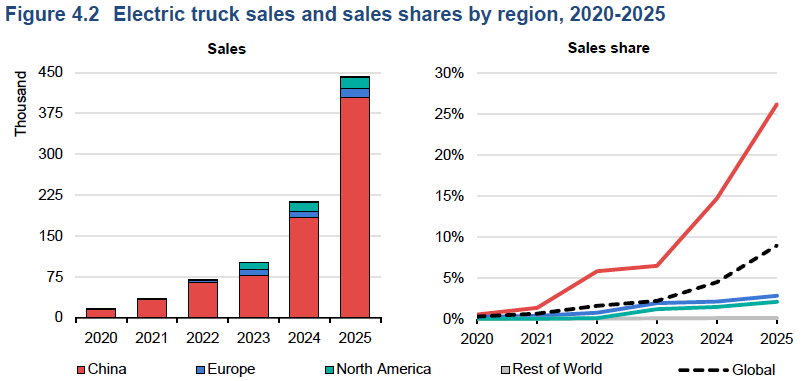
The IEA report points to another trend that is bad news for Alberta: the rapid electrification of medium and heavy-duty commercial trucks. “Growing deployment of electric trucks – the second-largest oil-consuming transport mode – avoids the consumption of 1 mb/d in 2035 based on current policies.”
China is the first major economy where electrification is visibly weakening oil demand growth at scale. Over the past decade, Beijing turned electric vehicles from an industrial policy experiment into a national manufacturing strategy, building dominant positions in batteries, EV production, and supply chains while simultaneously driving rapid domestic adoption.
As EVs replace internal combustion vehicles, gasoline demand growth slows because millions of drivers are no longer buying liquid fuel.
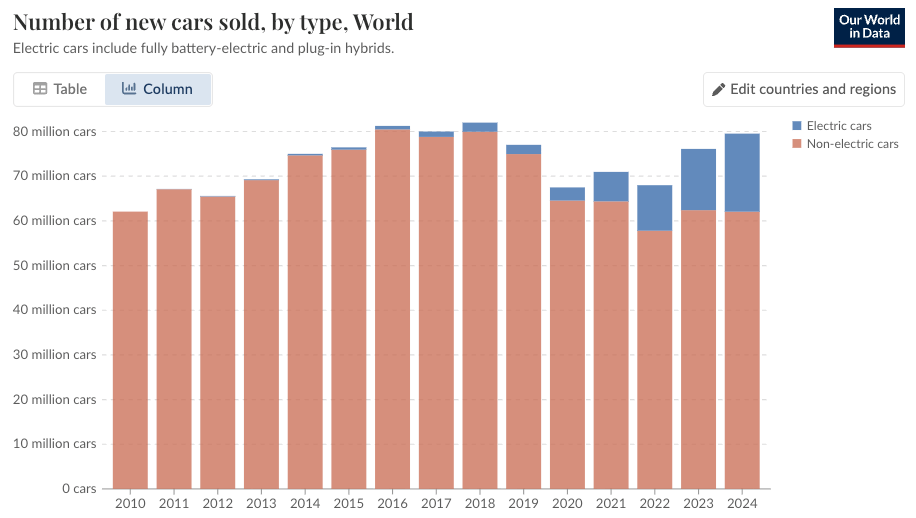
BloombergNEF now argues this effect is large enough to alter the trajectory of global oil markets: oil-demand growth weakens first in China — historically the world’s largest source of incremental crude demand — and then spreads outward into other emerging markets as Chinese EVs and batteries scale internationally.
In this framework, transport electrification is no longer a niche climate story. It is becoming a structural macroeconomic force reshaping global oil demand.
The IEA’s data suggests this shift is already underway. Southeast Asian EV sales more than doubled in 2025, with Vietnam reaching nearly 40% electric vehicle penetration in new car sales and Thailand approaching 25%. In the first quarter of 2026, immediately following the oil shock triggered by the Iran conflict, EV sales rose another 80% across Southeast Asia, while India’s climbed 65%.
The agency explicitly notes that countries facing supply concerns and steep fuel-price increases are seeing stronger EV adoption, particularly in lower-income economies where consumers are highly sensitive to gasoline and diesel costs. The economics are becoming difficult for policymakers to ignore: electrification reduces oil import exposure and dampens inflationary fuel shocks.
In effect, the IEA is describing the early stages of a structural transition in which EV adoption becomes an energy-security strategy for Asia’s import-dependent economies. This shifts transportation energy demand from globally traded hydrocarbons to domestically controlled electricity systems. The implication is that every major oil disruption now accelerates the incentives for Asian importers to electrify transport faster, build domestic battery industries, and reduce exposure to unstable maritime oil supply chains.
The paradox for oil exporters is becoming clearer: higher short-term oil prices drive Asian consumers to buy EVs, thereby strengthening the long-term forces eroding future oil demand that leads to lower medium to long-term prices.
Alberta’s Pipeline Optimism Has Turned Into a Delusion
Jean’s argument rests on a worldview that grows shakier by the week. In fact, this has been the case for years now. My problem with it is that oil’s future is a binary reality. Either flat out production growth for decades or keep it in the ground. There is no middle ground for a discussion of alternatives, perhaps a plan to gradually transition to non-combustion uses (eg carbon fibre, asphalt binder) as the global fuels market declines.
The evidence increasingly suggests that the era of endlessly expanding oil demand — the assumption underpinning decades of pipeline politics — is drawing to a close.
China’s electrification strategy is weakening transportation oil demand in the world’s most important growth market, Southeast Asia is rapidly following behind, and commercial trucking now appears poised for the same transition. Europe’s electrification has picked up speed once again. And China is aggressively exporting clean energy technologies to much of the Global South, especially in Africa and Latin America.
This creates a deeper problem that Alberta is ignoring: not that oil demand suddenly collapses, but that demand growth slows structurally while competing producers continue adding supply. In that world, the strategic challenge shifts from maximizing export capacity to competing in a lower-growth, more volatile, and increasingly electrified global energy system.
That is why claims that “the need for pipelines has never been greater” require far more evidence than memes on X.
Jean may as well added "at all public cost", both financial & environmental.
No oil company is planning on paying the freight on this so-called grand bargain.
The environmental goalposts & guardrails keep getting moved. CCUS served to greenwash the industry, now they'd get rid of it
Emission caps are being slow-walked further down the road.
Meanwhile Oil Sands oil production will remain as carbon intensive/expensive as ever, while thick viscous bitumen will be continue to be shipped in diluted form at added cost for diluents.
However, as Smith said about another subject: "...everyone knows that."